See the decision before comparing answers.
Name the governing purpose, legitimate claims, affected systems, uncertainties, and irreversible exposures before the most powerful function defines the problem.
BlackRidge EDGE Transition Guide · 2026
A proven senior leader receives enterprise authority—and discovers that the next decision cannot protect every stakeholder, remove every uncertainty, or prevent every consequence. EDGE is the passage from optimizing performance to carrying the institution.
Read the full report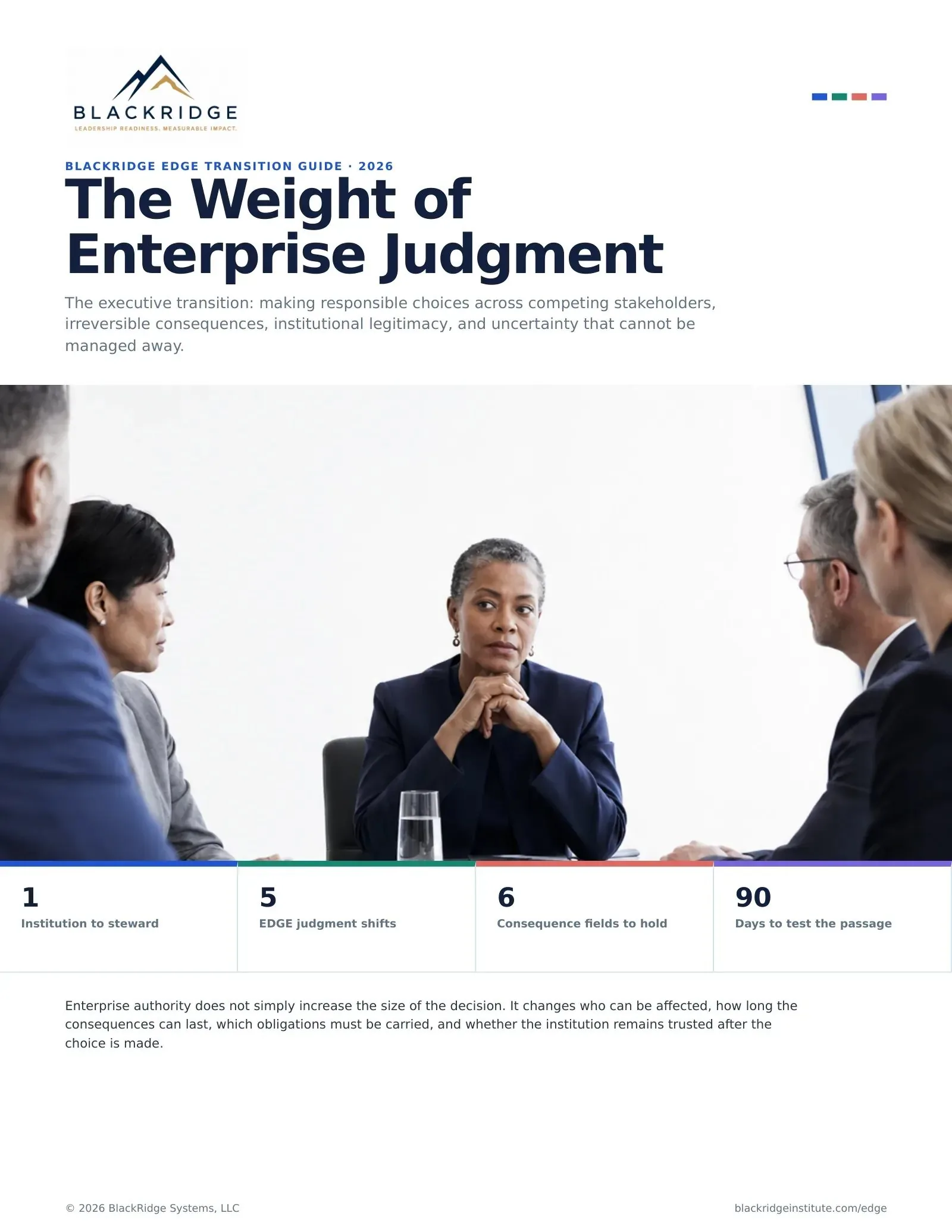
16 pages · EDGE transition guide
Executive authority does not arrive as a larger version of the last role. It arrives as wider consequence, decisions reaching culture, legitimacy, and the future of the organization.
BlackRidge designs development around the transition a leader is making. When the role changes, what leadership requires changes too, so every new role deserves new development.
This report covers the fourth of four transitions.
The moment often arrives as a decision no analysis can make clean: protect current performance or preserve future capability; move quickly or widen consultation; satisfy one legitimate claim while another group carries the cost.
The executive may have more data, authority, and advice than ever before, yet less certainty about what the system will do next. Employees, customers, owners, boards, regulators, communities, and future leaders can all be affected—often on different time horizons.
EDGE is BlackRidge’s transition for this moment. It prepares an executive to frame the real decision, interpret incomplete evidence, choose a responsible trade-off, own what follows, and revise without disguising uncertainty as failure.
BlackRidge findingEnterprise judgment is not the performance of certainty. It is the accountable construction of a responsible choice when evidence is incomplete, consequences extend beyond the room, and no stakeholder can be fully protected.
The executive first sees the wider decision, then chooses without pretending the conflict has disappeared, and finally carries the institution through the consequences.
Name the governing purpose, legitimate claims, affected systems, uncertainties, and irreversible exposures before the most powerful function defines the problem.
Integrate evidence, experience, values, timing, stakeholder consequence, reversibility, and the cost of delay when no option protects every legitimate interest.
Own the choice, protect institutional capability and trust, monitor second-order effects, preserve future options, and revise when a pre-established threshold is crossed.
00 · The BlackRidge position
This is the executive passage: the move from leading an organization well to carrying choices that can alter institutional purpose, capability, legitimacy, stakeholder confidence, and the options available to those who come next.
Imagine an executive deciding whether to close a facility, accelerate an unproven technology, restructure a public service, or preserve a capability that weakens this quarter’s result.
The spreadsheet shows one answer. Employees, customers, regulators, communities, and the institution’s future reveal several more. There is no choice without a burden. EDGE develops the judgment to make that trade-off visible, responsible, explainable, and revisable.

01 · Carry the institution
Earlier roles reward leaders for improving performance inside boundaries they understand. At EDGE, the choice crosses boundaries the executive does not control and creates consequences that may outlast the strategy, reporting period, or leader.
The executive must still produce results, but performance is no longer the complete standard. The choice must also preserve purpose, capability, legitimacy, relationships, trust, and long-term option value.
Use expertise, analysis, influence, and control to produce a better answer and deliver the stated result.
Construct a responsible choice across competing goods, legitimate claims, incomplete evidence, irreversible exposure, and institutional time.
02 · Decide beyond expertise
Expertise improves the inputs. Judgment determines what they mean together when valid evidence conflicts, values compete, the future can branch, and no answer is clean.

Compare expected value, distribution, tail exposure, controls, and limits when probabilities are stable enough to support calculation.
Separate facts from frames, seek disconfirming evidence, and prevent the most powerful function from defining reality alone.
Use scenarios, staged commitments, robust choices, exposure limits, and trigger points when future states cannot be forecast reliably.
Clarify principles, non-negotiable boundaries, sensing, institutional capacity, and adaptation when the current model cannot contain the future.
Do not demand more certainty than the environment can provide. Demand a decision architecture appropriate to what cannot be known.
03 · See beyond the stated result
A choice can be financially rational and institutionally damaging, operationally efficient and strategically narrowing, legally permissible and morally corrosive, or popular now and expensive to reverse later.

What changes first in revenue, cost, service, safety, delivery, people, mission, or public value?
Which interfaces, incentives, capacities, dependencies, or power relationships shift elsewhere in the enterprise?
How will employees, markets, regulators, competitors, communities, partners, or future leaders respond?
Which capability, relationship, right, option, source of trust, or institutional memory cannot be restored easily?
What behavior will this choice authorize, normalize, discourage, or make harder to refuse next time?
What will the decision teach stakeholders about whose interests and which values govern the institution?
Who receives the measurable benefit inside the reporting period?The decision ends where the stated metric ends.
Who receives the benefit, who absorbs the cost, what becomes harder later, and what must remain true?
04 · Design the choice
Enterprise judgment is personal, but it should not be solitary. The executive remains accountable for creating a process that improves evidence, reveals conflict, protects challenge, defines authority, and makes responsible revision possible.

Assign a credible person or team to build the strongest responsible case against the preferred option, including stakeholder, human, institutional, and second-order consequences.
Access depends on affirming the executive, experts debate details while the governing frame remains protected, and dissenters are remembered as disloyal after the choice.
05 · Lead beyond the reporting period
Stewardship asks a different question from performance optimization: what must this institution retain or become so it can continue to create legitimate value after the current decision, cycle, and leader?
Explain what the decision means for stakeholders: benefit, burden, timing, mitigation, recourse, and what remains uncertain.
Show the governing values, obligations, safeguards, and treatment of those affected rather than using legality or profitability as the complete argument.
Connect the choice to purpose, history, operating reality, and a coherent institutional identity so authority does not appear arbitrary.
Make the process, final authority, dissent, evidence standard, accepted cost, and mechanism for review sufficiently visible.
Keep mission, public value, customer promise, and governing intent visible when immediate pressure rewards drift.
Preserve knowledge, leadership, operating resilience, relationships, technology, and the capacity to adapt.
Align choice, process, explanation, and consequence so stakeholders can understand how power was used.
Preserve choices that may matter under different conditions instead of optimizing the present by closing the future.
A polished message cannot repair a decision process that treated people as scenery, disguised accepted costs, or staged consultation after commitment.
Trust does not require every stakeholder to prefer the decision. It requires evidence that consequence was seen, power was used responsibly, and correction remains possible.
06 · Test EDGE readiness
The goal is not an executive who always appears certain. It is evidence that the leader can carry authority, uncertainty, consequence, and institutional trust at the same time.

Ambiguity is converted into confidence theater, and questions are treated as weakness after a position is announced.
Only powerful, proximate, measurable, or vocal groups enter the decision frame.
Advice improves the preferred answer but cannot challenge the executive’s definition of the problem.
The reporting period consumes capability, trust, optionality, and future value the metric does not record.
A path-dependent commitment is described as a test, pilot, or reversible step to reduce scrutiny.
Name purpose, stakeholder claims, inherited commitments, uncertainty, decision rights, hidden assumptions, and irreversible exposures.
Lead structured challenge, choose the obligation that governs, state accepted costs, and set thresholds before the outcome is known.
Review first- and second-order effects, protect critical capability, respond to burdened stakeholders, and revise when evidence requires it.
Can the executive integrate evidence, context, values, and uncertainty without replacing them with certainty performance?
Can the executive see systemic, second-order, irreversible, human, and reputational effects beyond the stated metric?
Can the executive protect purpose, capability, legitimacy, relationships, and future options while making a present trade-off?
Can the executive preserve challenge, own the choice, explain its logic, and revise through thresholds rather than ego?
When the institution cannot protect every legitimate interest, can the executive show what governed, what was sacrificed, who carries the burden, and why the choice remains responsible?
The executive passage
EDGE readiness appears when an executive can act without pretending certainty, make the governing obligation visible, carry the burden created by the trade-off, protect the institution’s future capacity, and revise without surrendering accountability.
We’ll help you think through the development it requires. A short reply from someone who read what you wrote, within two working days, whether you are a talent development lead, an HR business partner, or the sponsor of the move.