Four transitions. Start with the one your leaders are in.
See the transitions →Find the transition you are making, and what it asks of you.
Find your transition →Pipelines hold when each transition is prepared for on its own terms.
See the four transitions →Five working papers on SSRN and nine published field reports.
Read the research →of first-time people leaders say they received no training at all when they moved into the role.
SHRMis the window in which the majority of people fail after taking on a new leadership role.
SHRMof CHROs named management skills their top focus area for 2026, the single largest priority in the study.
SHRM CHRO PrioritiesDevelopment is not missing because organizations do not value it. It is missing at the exact moment responsibility changes hands.
We build and run leadership development for supervisors, managers, senior leaders and executives: programs, workshops, seminars, and coaching. We measure where leaders stand before development starts, and what changed after it ends. And we publish the research behind it.
Supervisor, manager, senior-leader, and executive development.
Focused leadership and professional-development sessions tailored to organizational needs.
Individual, cohort, pipeline, and organizational insight that informs development.
Curriculum design, facilitation, succession support, organizational readiness, and development evaluation.
Our specialty is leadership transition. Our capability is leadership development.
Explore our capabilities →
Leadership transitions change more than responsibilities. They change how decisions get made, how work gets accomplished, how relationships operate, and what others need from the leader. BlackRidge makes those transitions visible, and development actionable.
See the five stages, from framing to evidence →BlackRidge does not begin with a course catalog. We begin with the transition, the role, the responsibilities, the decisions, the relationships, and the operating context, and design the development around it. We customize the curriculum to the transition.
See what the role ahead actually requires.
Know what to leverage and what to build.
Support new leadership practices where the work happens.
Leaders develop inside real teams, real workloads, real expectations, and real operating environments. BlackRidge considers both the leader and the conditions surrounding the transition, so development can be focused where it will matter.
See how conditions change the plan →
Each stage carries into the next. What we learn about the transition shapes the development, and what happens back at work shapes what comes after it.
Understand the transition ahead.
See what to leverage and what to build.
Turn insight into focused practice.
Strengthen the conditions for application.
See what changed and what comes next.
As responsibility expands, the work of leadership changes. BlackRidge development pathways are built around those changes.
The move from personal contribution to achieving results through others.
The move from direct leadership to building performance through managers.
The move from functional success to broader organizational leadership.
The move into enterprise judgment, complexity, interdependence, and consequence.
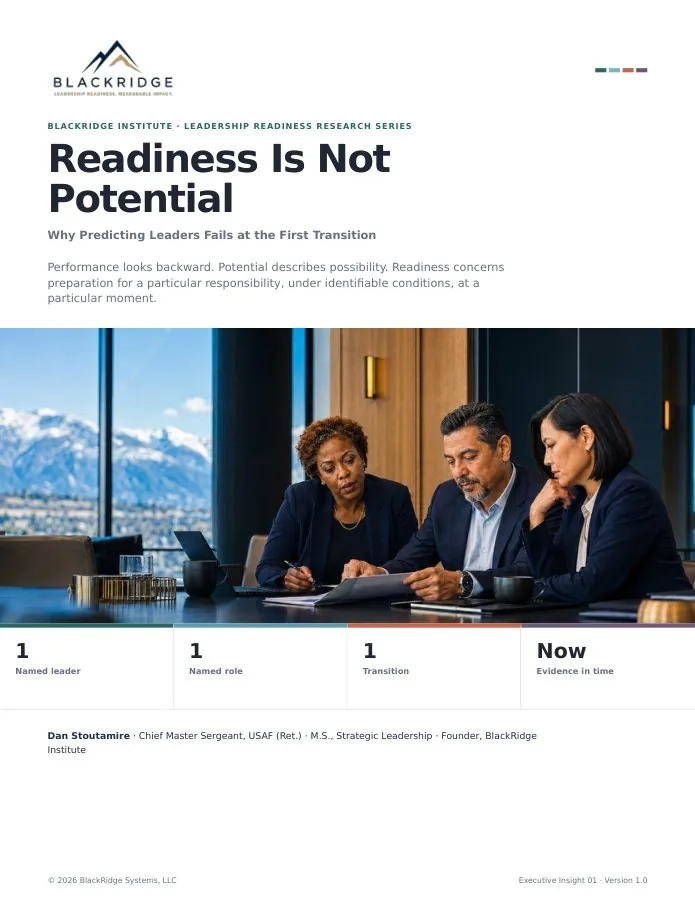
Readiness Is Not Potential
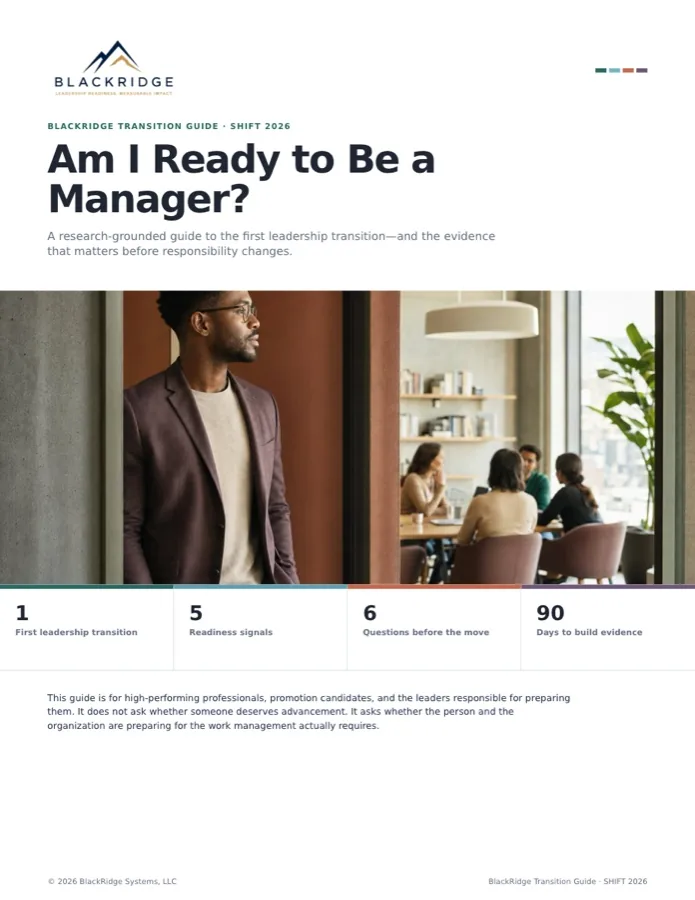
Am I Ready to Be a Manager?
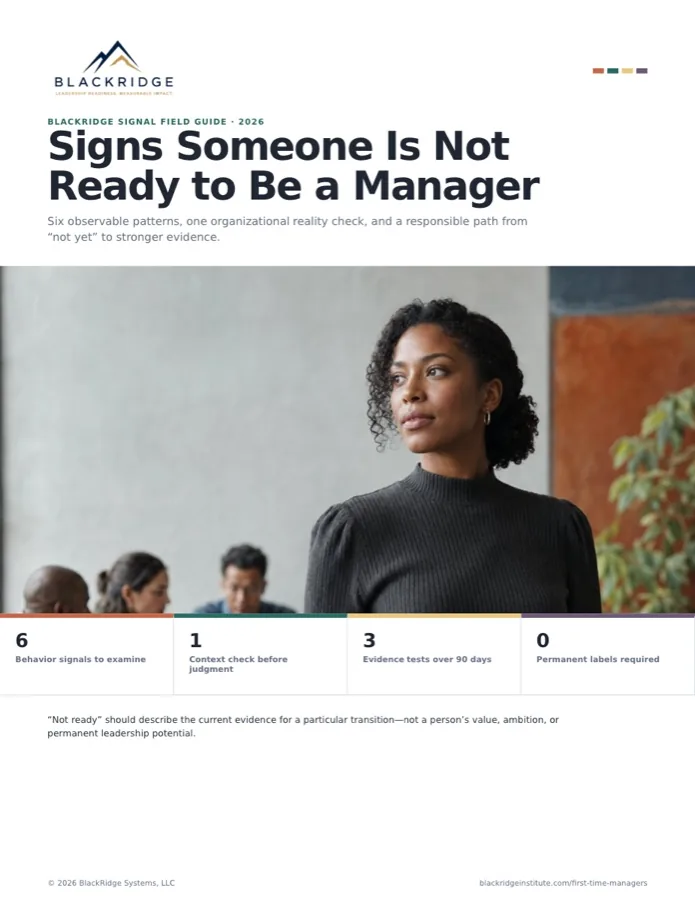
Signs Someone Is Not Ready to Be a Manager
How Do You Know Someone Is Ready for Promotion?
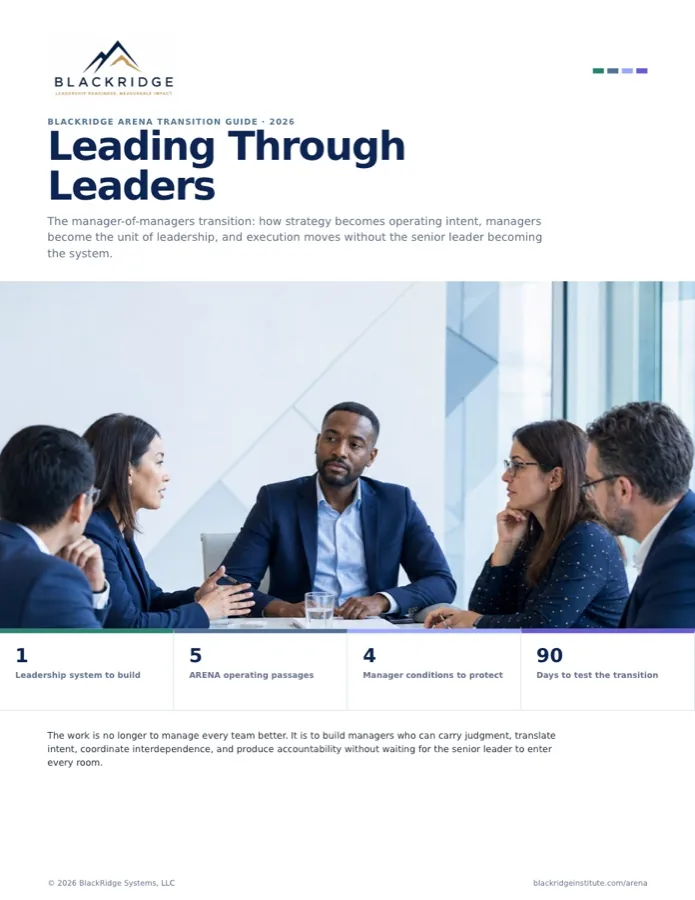
Leading Through Leaders
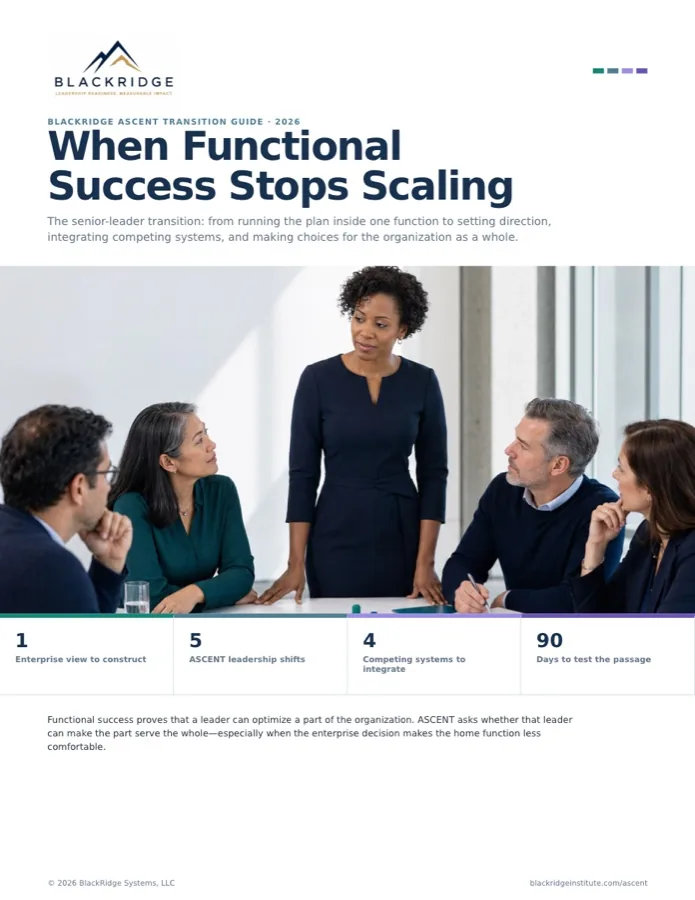
When Functional Success Stops Scaling
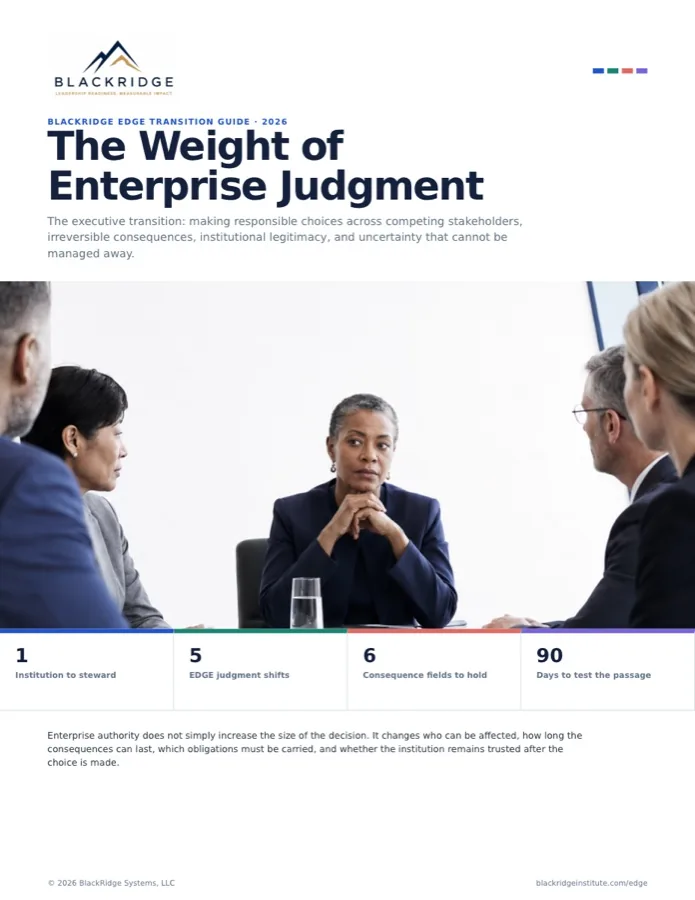
The Weight of Enterprise Judgment
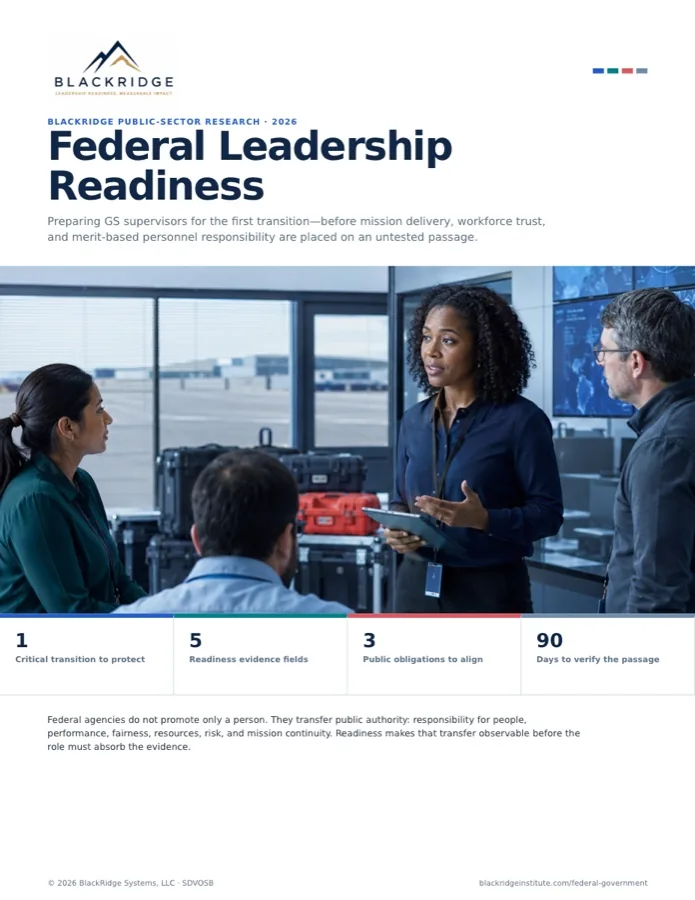
Federal Leadership Readiness
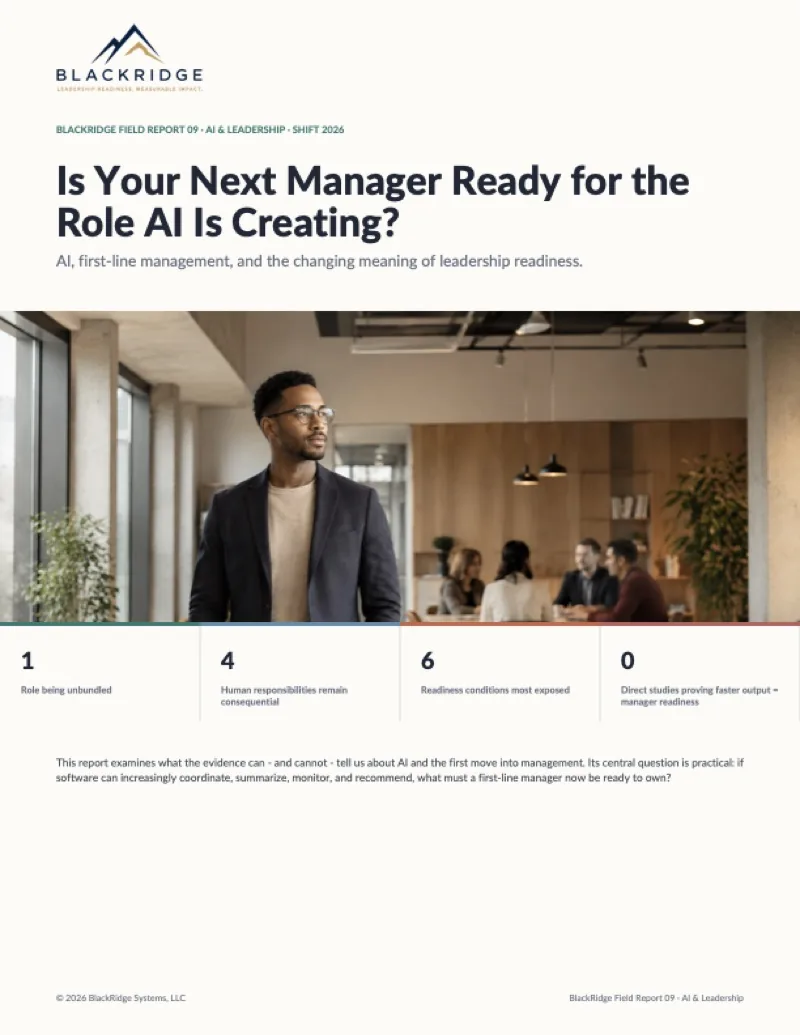
Is Your Next Manager Ready for the Role AI Is Creating?
Readiness Is Not Potential
Am I Ready to Be a Manager?
Signs Someone Is Not Ready to Be a Manager
How Do You Know Someone Is Ready for Promotion?
Leading Through Leaders
When Functional Success Stops Scaling
The Weight of Enterprise Judgment
Federal Leadership Readiness
Is Your Next Manager Ready for the Role AI Is Creating?
BlackRidge connects leadership development to the transition itself, the work leaders return to, and the progress that follows. The goal is not simply greater insight. It is development leaders can use.
A first-time manager and an enterprise leader are not solving the same problem. Development is shaped around the specific responsibility a leader is stepping into, not a general curriculum applied to everyone.
We look at the leader and at the conditions around them, decision rights, managerial support, room to try things. The same visible problem can sit in either place, and the right development depends on which.
Insight that stays in a workshop changes nothing. Development connects to real decisions, real teams, and the conditions a leader returns to on Monday morning.
Reassessment shows what changed and what comes next, evidence of movement rather than attendance records and satisfaction scores.
New working papers and field reports, sent when they are released. No campaigns, no drip sequence, the research, when there is research.