AI, first-line management, and the changing meaning of leadership readiness.
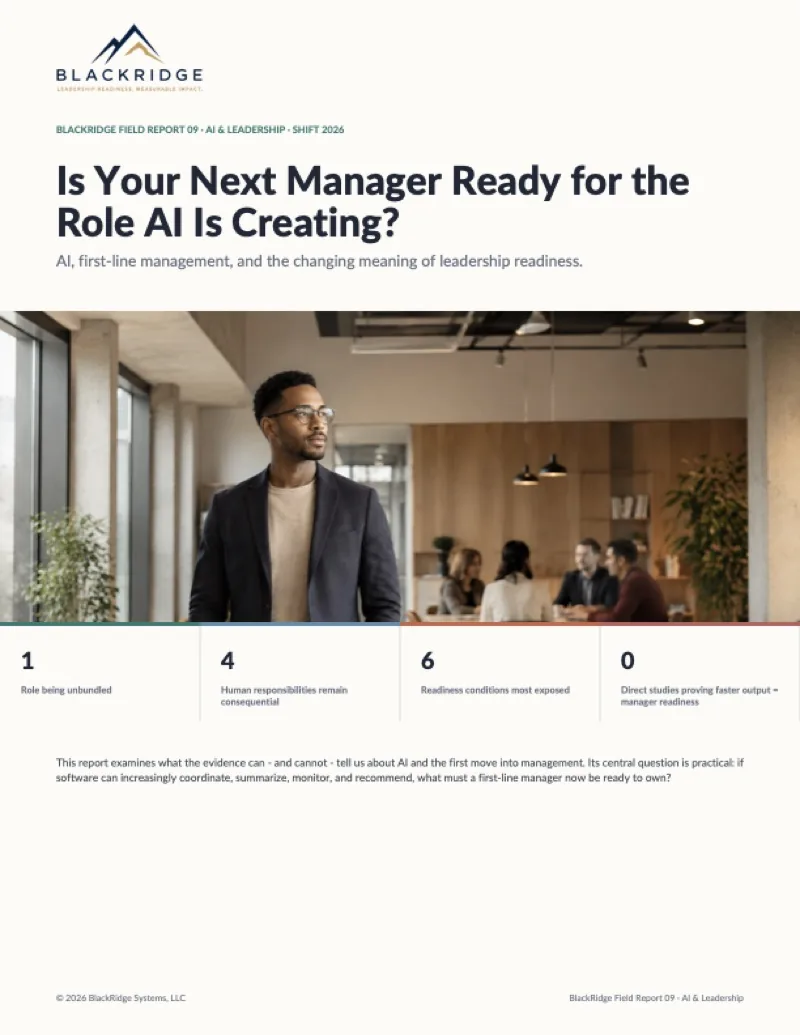
This report examines what the evidence can, and cannot, tell us about artificial intelligence and the first move into management. Its central question is practical: if software can increasingly coordinate, summarize, monitor and recommend, what must a first-line manager now be ready to own?
Sixteen pages. Free to read, free to cite, no email required.
Software already assists a meaningful portion of the coordination bundle that historically sat close to first-line supervision: schedules, work allocation, monitoring, summaries, feedback preparation, routine guidance and decision support. The evidence is strongest for assistance and partial automation, not autonomous replacement.
The role is not disappearing. Parts of it are becoming cheaper, faster, and more software-mediated.
Judgment, exceptions, conflict, legitimacy, interpersonal reading, and accountability remain consequential.
Inside its capability frontier, performance can rise. Outside it, fluent recommendations can make people worse.
AI can compress a novice task curve without proving that independent managerial judgment developed at the same speed.
The readiness question changes: can this person remain the accountable human when AI shapes the work, the evidence, and the recommendation?
Thirteen passages. Each one either teaches a distinction, interprets evidence, or gives a reader a practical way to think differently about the transition ahead.
Some structural changes are observable. The stronger causal claims are not yet established. Separating the two is what makes the argument useful rather than fashionable.
Spans widened in some United States small-business data, from roughly three direct reports in 2019 to nearly six in 2024. That dataset contains no AI-adoption measure.
A 2026 analysis of 21,559 firms found high-intensity adopters increased manager headcount 6.7 percent while entry-level headcount rose 12.0 percent. Manager share fell. Manager headcount still grew.
Administrative records covering more than 50 million people showed promotion rates cooling after the 2021 to 2022 peak and returning roughly to the 2019 baseline. The data do not measure AI.
AI clearly accelerated novice task productivity in bounded settings. No study located tracked newly promoted first-line managers and measured time to proficiency on team outcomes, trust, conflict, or fairness.
Treat AI-driven flattening, first-promotion disappearance, and shorter manager ramp as hypotheses to test, not trends already proven.
This report is a research-informed guide for making AI-mediated first-line management more explicit and developable. It is not an independently validated promotion test, an AI competency score, a guarantee of performance, or an automated recommendation about who should become a manager.
AI is changing the role ahead.
Readiness must change with it.
The question is not whether a future manager can use AI. It is whether that person can remain accountable when AI shapes the work, the evidence, and the recommendation.
We’ll help you think through the development it requires. A short reply from someone who read what you wrote, within two working days, whether you are a talent development lead, an HR business partner, or the sponsor of the move.