Artificial intelligence is changing more than how work gets done. It is changing what leaders are responsible for, which decisions require human judgment, how teams operate, and what organizations should expect from the people stepping into leadership roles.
If the role ahead is changing, are we still preparing leaders for the right role?
BlackRidge studies AI through that lens: not as a technology problem, but as a change in the demands leaders must be prepared to carry.
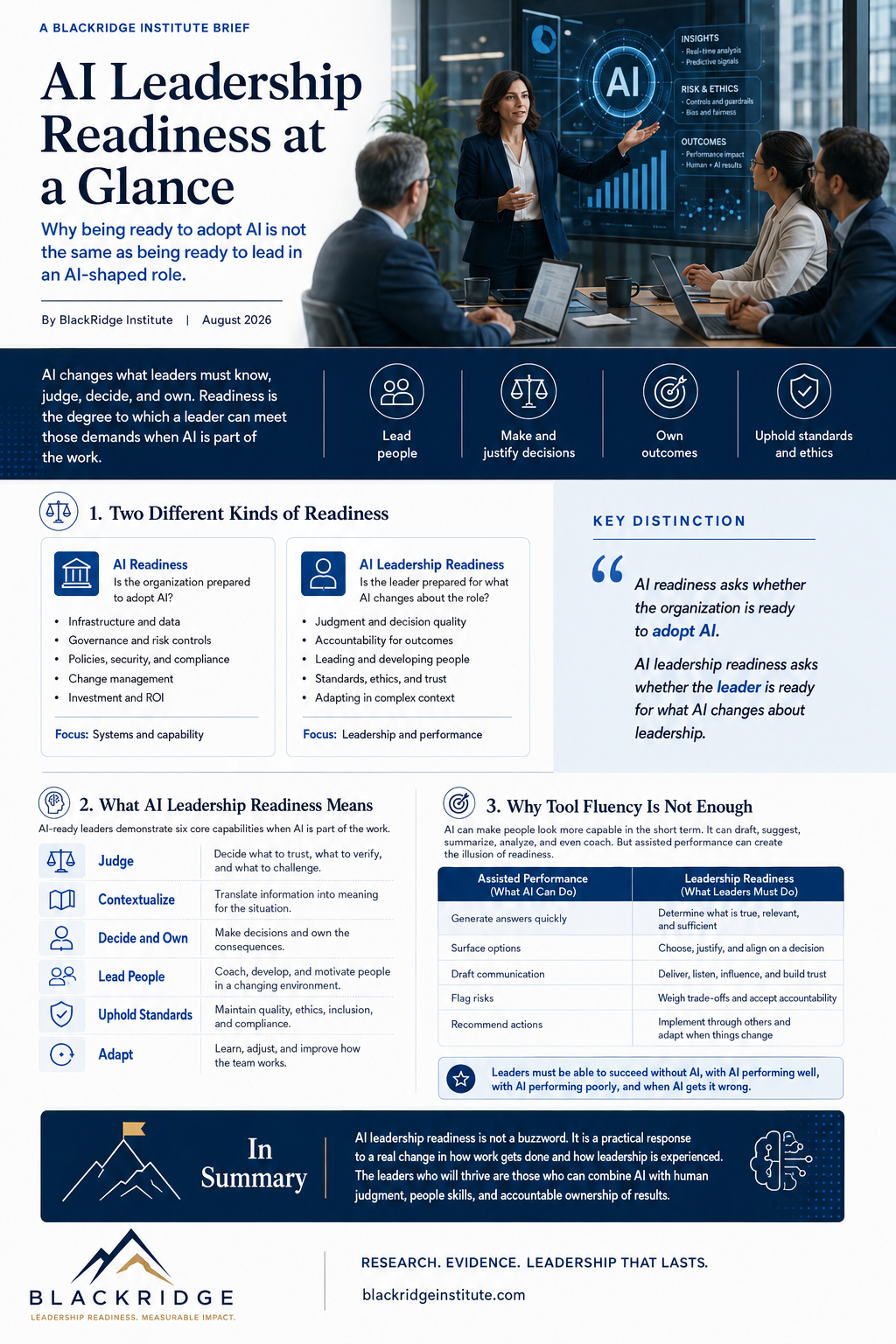
AI leadership readiness is the degree to which a leader is prepared to exercise judgment, lead people, make accountable decisions, and carry the responsibilities of a role whose work and operating environment are increasingly shaped by artificial intelligence.
asks whether an organization is prepared to adopt artificial intelligence.
asks whether its leaders are prepared for what artificial intelligence changes about leadership.
This is a framing we are proposing and developing, not an established construct in the literature. We say so because the distinction between what is demonstrated and what is proposed is the discipline this work depends on.
A first-line manager does not do one kind of work. The job has always bundled four different kinds together, and we rarely separate them because one person did all four. Artificial intelligence is now separating them for us, and it is doing so from one end.
Read the four in order. Each one is harder to hand to a machine than the one above it.
Building the schedule. Allocating the work. Tracking who is doing what, chasing what is late, and turning all of it into a status update somebody upstream will read.
Deciding whether the numbers describe what actually happened. Knowing that the dashboard is accurate and still incomplete, because it does not contain the reason.
Handling the exception, the disagreement, and the employee who believes the decision was unfair. Repairing trust once it has already been damaged.
Carrying the consequence. Explaining the decision to the person it affected, to your own manager, and sometimes to a regulator. Being the one who answers for it.
For most of the history of first-line management, being good at the top of that list was how a new manager proved themselves. It was visible, it was measurable, and it filled the first year. Software is now absorbing much of it. What is left is the part that was always hardest and was never the part anyone was promoted for.
As the cost of coordination falls, readiness becomes less about being the team’s information router and more about governing a human and machine work system.
Both matter, and they are not interchangeable. Development builds capability. Readiness is the judgment about whether that capability meets what the role now asks.
A course can develop a set of behaviours well and still leave the question open: whether this leader, in this role, under these conditions, is prepared for what the role has become.
Development designed against the role as it was will prepare someone accurately for demands that have already shifted. The opening question is what changed about the role, not what to teach.
Once you know what the role now demands, and where a leader stands against it, the choice of development follows from evidence. Beginning with the catalogue reverses the order.
Development still does the work. Readiness decides where it should go.
Artificial intelligence can compress how long it takes someone to produce competent work. Evidence for that is strong. Evidence that it compresses how long it takes someone to become ready to lead does not exist.
A person can be faster and more fluent with a tool without having developed the independent judgment required when that tool is wrong, unavailable, or working outside what it can reliably do.
Approval is not oversight. Accountability means being able to reconstruct the decision, say what evidence was used and what was left out, and defend or reverse it afterwards.
Taken together, these move the readiness bar. It shifts from producing answers toward governing decisions.
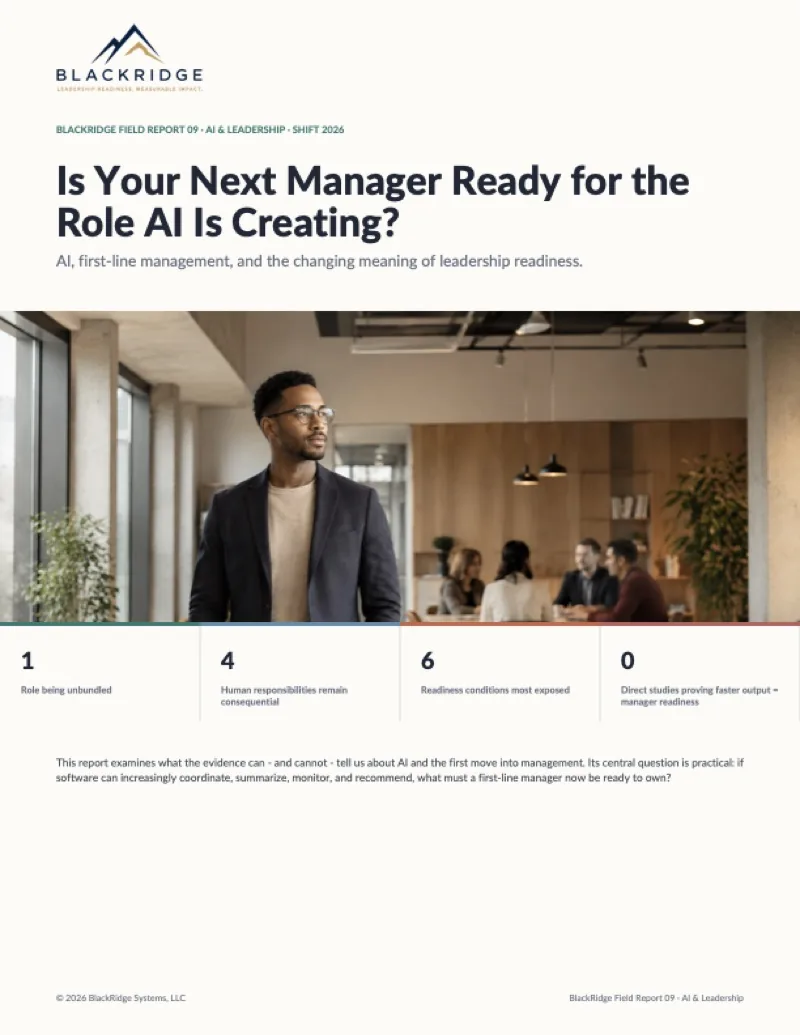
AI, first-line management, and the changing meaning of leadership readiness.
AI is changing the work first-line managers coordinate, the information available to them, and the decisions they must ultimately own. This report examines what those changes mean for judgment, accountability, and readiness for the first leadership transition.
Free to read, free to cite.
Our readiness architecture should not be replaced by an AI scale. These six conditions have the closest current evidence connection to AI-mediated first-line work. They are evolving behavioral contexts, not newly validated constructs.
Trace what evidence was used, what was missing, who may be affected, and how a decision can be corrected.
Calibrate trust to task fit, stakes, uncertainty, reversibility, and model capability.
Detect repeated model errors, group disparities, missing context, and distribution shifts across cases.
Notice deference, reflexive distrust, confirmation seeking, cognitive offloading, and relief-driven acceptance.
Read reactions to monitoring, automated evaluation, silence, fear, and perceived procedural unfairness.
Select among AI, data, peers, specialist expertise, escalation channels, and direct human conversation.
The readiness bar shifts from answer production to decision governance.
Our research basis is strongest at the first transition, which is where Report 09 concentrates. The other three are questions we are examining, and we mark them as such.
The first-line transition is where our research basis is strongest, and where Report 09 concentrates.
BlackRidge examines how AI may change delegation, decision rights, and leadership through leaders.
BlackRidge examines how AI may change integration, alignment, and the pace at which complexity grows.
BlackRidge examines how AI may change governance, ethical judgment, and institutional accountability.
Some structural changes are observable. The stronger causal claims are not yet established. Separating the two is what makes the argument useful.
Spans widened in some United States small-business data, from roughly three direct reports in 2019 to nearly six in 2024. That dataset contains no AI-adoption measure.
A 2026 analysis of 21,559 firms found high-intensity adopters increased manager headcount by 6.7 percent while entry-level headcount rose 12.0 percent. Manager share fell. Manager headcount still grew.
Administrative records covering more than 50 million people showed promotion rates cooling after the 2021 to 2022 peak and returning roughly to the 2019 baseline. The data do not measure AI.
AI clearly accelerated novice task productivity in bounded settings. No study located tracked newly promoted first-line managers and measured time to proficiency on team outcomes, trust, conflict, or fairness.
Treat AI-driven flattening, first-promotion disappearance, and shorter manager ramp as hypotheses to test, not trends already proven.
AI leadership readiness is the degree to which a leader is prepared to exercise judgment, lead people, make accountable decisions, and carry the responsibilities of a role whose work and operating environment are increasingly shaped by artificial intelligence. It is a question about the person stepping into the role, not about the organization’s technology adoption.
Artificial intelligence is absorbing much of the coordination work that historically defined first-line supervision: scheduling, allocation, monitoring, reporting, and routine guidance. What remains with the leader is contextual judgment, exceptions, conflict, legitimacy, trust, and consequence. The role is being unbundled rather than removed, and the demands on the person are changing accordingly.
The available evidence does not support that claim. Software assists a substantial share of supervisory coordination, but assistance is far better established than full automation. Some organizations are becoming relatively flatter while still adding managers. The defensible conclusion is that managerial leverage is changing, not that the role is disappearing.
Calibrated reliance, meaning knowing when to check, override, escalate, or delay. Detection of patterned rather than isolated error. Willingness to own a decision that a machine helped produce. Interpersonal reading of reactions that never reach a dashboard. These are not soft skills. They are the work that cannot be delegated to a system.
Selectively, and with calibration. Experimental evidence shows AI improving performance on tasks inside its capability range and degrading it on tasks outside that range, while producing equally fluent justifications either way. Confidence should track evidence quality, task fit, and reversibility, not the polish of the output.
Decisions where a person carries the consequence. Discipline, dismissal, promotion, and the resolution of conflict all require legitimacy that a recommendation cannot confer. A system can assemble evidence and propose an answer. It cannot sit in the room, absorb the reaction, or be accountable afterwards.
Begin by asking what AI has changed about the receiving role, before designing any development. Most programs still prepare people for the role as it was. If the work, information, and decision boundaries have moved, then development built on the old assumptions prepares leaders accurately for a role that no longer exists.
The first-line transition has always rested partly on knowing the work best. When AI can produce competent output on demand, that informational advantage narrows. The new manager’s value shifts toward framing work, challenging outputs, setting standards, developing people, and remaining accountable for results they did not personally produce.
Naming a successor has never been the same as knowing they are ready. AI widens that difference, because the role a successor is being prepared for may not be the role they will inherit. Succession planning that does not ask what the receiving role now demands is planning against an outdated description.
The framing question changes first. Before diagnosing a person or designing a program, an organization has to establish what artificial intelligence has changed about the role ahead. Development that begins with curriculum rather than with the receiving role will train people thoroughly for demands that have already moved.

Each piece examines one part of the question. All of it is free to read and free to cite.
The definition, and why it is a different question from whether an organization is ready to adopt AI.
Read it →AI changes the informational advantage that has traditionally accompanied expertise, and raises new questions about what readiness for first-line management should look like.
Read the paper →AI is changing the role ahead.
Leadership readiness must change with it.
We’ll help you think through the development it requires. A short reply from someone who read what you wrote, within two working days, whether you are a talent development lead, an HR business partner, or the sponsor of the move.