Home / Research / How Do You Know Someone Is Ready for Promotion?

BlackRidge Executive Evidence Guide · 2026

How Do You Know
Someone Is Ready
for Promotion?

A research-grounded framework for replacing promotion intuition with role-relevant evidence—without reducing a consequential human decision to a score.

AuthorDanyell Stoutamire
FieldLeadership Readiness
Read the full report
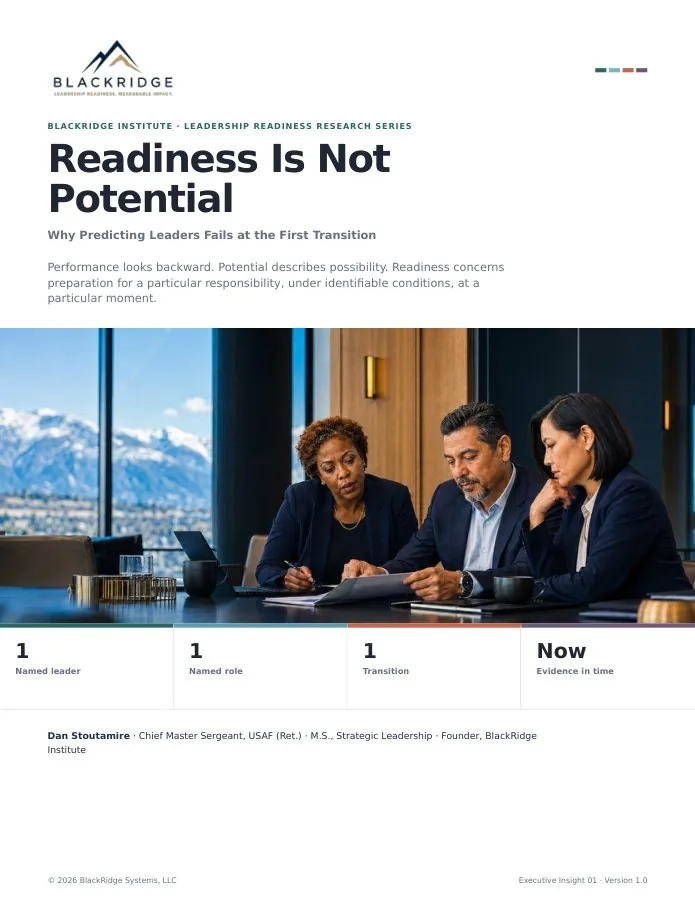
Cover of How Do You Know Someone Is Ready for Promotion?

16 pages · Executive evidence guide

The question usually asked is who has earned it. The question that decides the outcome is what changes.

Earning and preparing are different judgments, answered by different evidence. One reads a record. The other reads the responsibility about to change hands.

BlackRidge builds the second kind of evidence, around the transition a leader is making. When the role changes, what leadership requires changes too, so every new role deserves new development.

This report covers the first of four transitions.

1Future roleto define
5Evidence standardsto apply
4Decision pathsto consider
90Daysto examine the move

The strongest promotion decision begins by refusing the wrong question.

The question is not “Who deserves the opportunity?” It is: What responsibility will change, and what evidence shows that this person is preparing to carry it?

Organizations promote people who perform, solve difficult problems, earn trust, show ambition, and become indispensable. Those signals matter. They are also incomplete whenever the next role changes the source of value, the relationships through which results are produced, or the scale and consequence of judgment.

Executive findingA defensible promotion case is not a stack of favorable opinions. It is an explicit argument connecting future-role demands to multiple sources of behavioral evidence—with limitations and organizational conditions visible.

Three ideas change the quality of the decision.

Promotion readiness becomes clearer when the organization stops treating past success, potential, and confidence as interchangeable with future-role evidence.

01

Performance is relevant—but bounded.

Past success describes capability already demonstrated. It cannot, by itself, establish readiness for work whose source of value is about to change.

02

The future role must be named first.

Readiness is relational. Define the decisions, relationships, pressure, scale, and consequences ahead before evaluating the person.

03

Evidence must resemble the responsibility.

The closer evidence comes to the work ahead—and the more clearly behavior can be observed—the more weight it deserves.

00 · The BlackRidge position

Promotion readiness is a bounded judgment—not a claim about a person’s worth.

It is a judgment about the match between a person, the work that changes, the evidence available, and the conditions into which responsibility will move.

Definethe delta
Structurethe inquiry
Observebehavior
Interpretcontext
Tracktrajectory

01 · The promotion problem

Organizations are often selecting the right person for the wrong evidence.

Promotion systems usually recognize excellence. The failure occurs when evidence of excellence in one role is treated as evidence of readiness for different work.

The evidence substitution

When future-role evidence is weak, panels substitute what is available: performance ratings, reputation, tenure, urgency, sponsorship, or confidence.

  1. Current-role performance
  2. Becomes a potential label
  3. Becomes a promotion case
  4. Without testing the role delta

What is valid

Performance, trust, and experience matter. They should enter the case as specific evidence—not as automatic transfer.

What is missing

Evidence tied to the decisions, relationships, pressure, and scale of the role ahead.

02 · Name the work that changes

Readiness begins with the role delta—not the candidate.

Before evaluating a person, define the new source of value, the relationships that change, the decisions that become theirs, and the consequences the organization is asking them to carry.

SHIFT

From doing the work to producing results through others

Ownership of team outcomes, delegation, decision confidence, composure, and renegotiation of former-peer relationships.

ARENA

From managing a team to leading through leaders

Proxy agency, manager development, cross-functional influence, standards across teams, and disciplined distance from direct execution.

ASCENT

From functional success to organizational direction

Systems thinking, integration, strategic patience, organizational navigation, and development of other managers.

EDGE

From organizational leadership to enterprise stewardship

Consequential judgment, capital and risk architecture, system trade-offs, external influence, and institution-level direction.

If the panel cannot explain what becomes different after promotion, it cannot know whether the evidence it is reviewing is relevant.

03 · What deserves weight

Five tests for promotion evidence.

Evidence becomes decision-worthy when the panel can describe why it is relevant, how it was observed, what it means, what limits it, and whether the pattern is stable enough to act on.

01

Role relevance

Does the evidence resemble the responsibility, relationships, and judgment of the next role?

02

Behavioral specificity

Can the panel identify what the person actually did—not merely an adjective assigned to them?

03

Multiple sources

Does the pattern appear across observation, structured inquiry, work artifacts, and credible raters?

04

Context visibility

Were authority, information, incentives, support, pressure, and opportunity considered?

05

Trajectory

Is the behavior forming, strengthening, holding, plateauing, or blocked across time?

Weak assertion She is strategic. No behavior, situation, or role connection.
Decision-worthy revision In two cross-functional decisions, she identified downstream effects, made assumptions explicit, and changed the plan when new evidence emerged.

04 · From assertion to observation

Not all evidence should carry the same weight.

The closer the method comes to the work ahead—and the more clearly the behavior can be observed and interpreted—the stronger its contribution to the promotion case.

01Observed workplace behavior over timeRepeated role-relevant behavior · credible raters · visible context
02High-fidelity simulation or stretch assignmentRealistic responsibility · structured observation · common standards
03Structured behavioral or situational interviewComparable questions · anchored scoring · evidence-specific probes
04Work artifacts, multisource input, performance historyUseful when relevance and limitations are explicit
05Reputation, confidence, tenure, unsupported labelsSignals that generate hypotheses—but should not close the case

Triangulation

Strong cases look for convergence and contradiction across methods, occasions, raters, and conditions.

Disconfirmation

Ask what evidence would make the preferred interpretation less likely. Advocacy without disconfirmation becomes sponsorship, not evaluation.

05 · Act without pretending certainty

Four responsible promotion paths.

A strong system does not force every case into yes or no. It distinguishes preparation, evidence sufficiency, timing, organizational conditions, and the risk the organization is prepared to carry.

Path 01

Proceed

Role-relevant evidence is strong enough to act. Name the support, decision rights, sponsor responsibilities, and early checkpoints.

Path 02

Prepare

The case is promising, but named demands remain underdeveloped. Build targeted practice and repeat the evidence.

Path 03

Pause

The person may be preparing, but authority, workload, sponsorship, or role clarity would make the transition structurally fragile.

Path 04

Gather

The case is too thin, contradictory, or reputation-dependent. Create a fair opportunity to observe the work.

06 · The organization is part of readiness

The promotion decision does not end when the title changes.

The receiving environment determines whether new behavior has authority, opportunity, information, reinforcement, and enough time to become stable.

Before Day 1

Role delta, authority, evidence, sponsor agreement

Days 1–15

Relationship reset, standards, decision rights

Days 16–30

Delegation, early decisions, evidence review

Days 31–60

Repeat patterns, barriers, development response

Days 61–90

Trajectory, changed behavior, remaining fragility

Ask at 90 days

What has strengthened, what remains fragile, and what support or structural change is now required?

Promotion readiness

Do not ask one role to predict another without examining what changes.

Define the responsibility. Structure the inquiry. Observe the behavior. Interpret the conditions. Track what changes after the move.

Download the 16-page report
Next In This Series

Keep reading

See the full research library →
Ready to talk?

Tell us where responsibility is changing.

We’ll help you think through the development it requires. A short reply from someone who read what you wrote, within two working days, whether you are a talent development lead, an HR business partner, or the sponsor of the move.

Thank you. We will reply within two working days.