Home / Research / Am I Ready to Be a Manager?

BlackRidge Transition Guide · SHIFT 2026

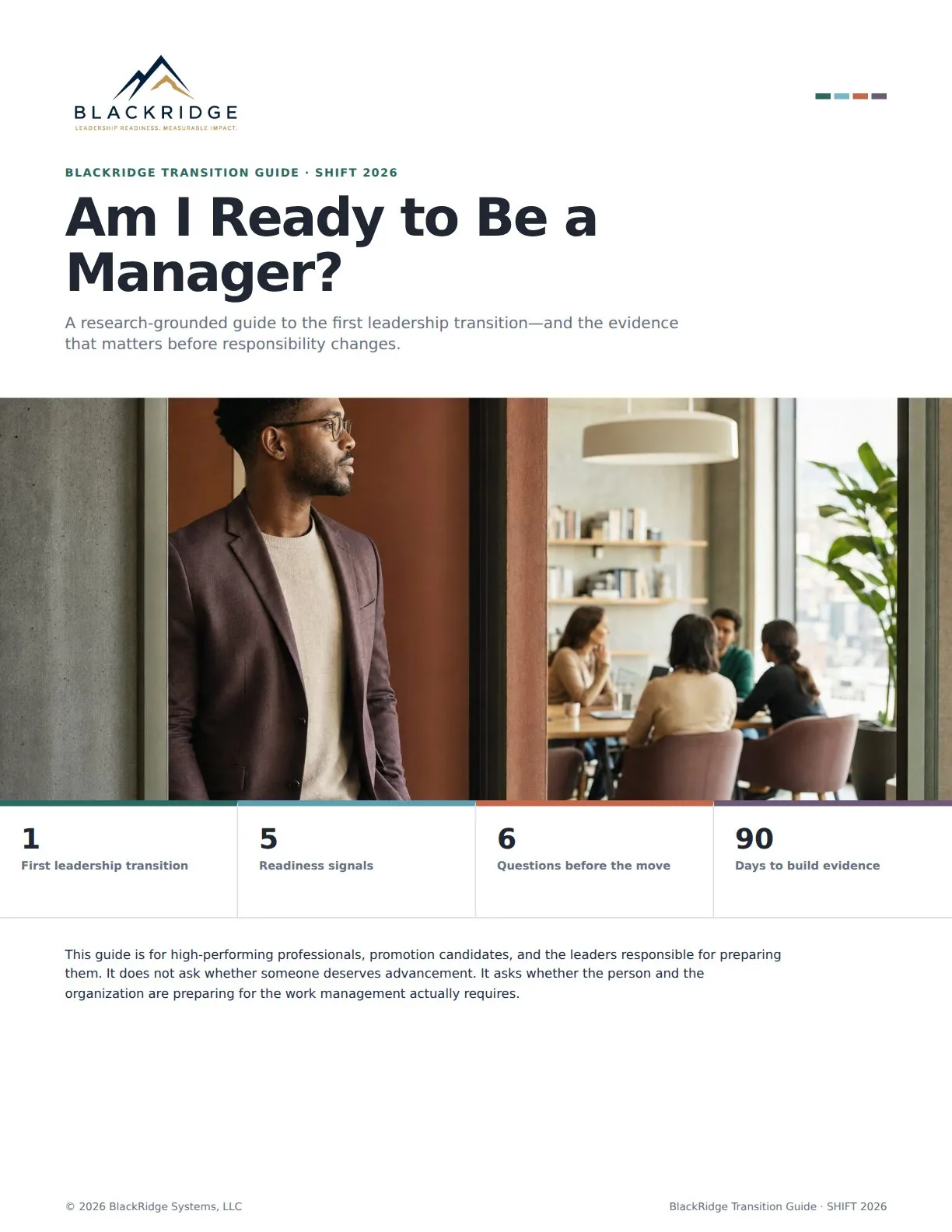
Am I Ready to Be a Manager?

A research-grounded guide to the first leadership transition—and the evidence that matters before responsibility changes.

FocusFirst leadership transition
Reading timeApproximately 12 minutes
Read the original report
Cover of Am I Ready to Be a Manager?

16 pages · BlackRidge Transition Guide

You are being asked to do a job you have not done, and judged on one you have.

The record that earned the opportunity is real. It describes work you already understand, and management is not more of that work. It is responsibility for other people’s clarity, standards, and development.

BlackRidge builds development around the move you are making, not around a job title. When the role changes, what leadership requires changes too, so every new role deserves new development.

This report covers the first of four transitions.

1First transitionInto management
5Readiness signalsBehavioral evidence
6QuestionsBefore the move
90DaysTo build evidence

You are not deciding whether you can handle more work.

You are deciding whether you are prepared to become responsible for other people’s clarity, performance, development, standards, and experience of leadership.

That is why the strongest individual contributor can still find the first management role destabilizing. The work does not simply increase. The source of value changes.

BlackRidge calls this first passage SHIFT: the move from individual contribution into responsibility for people, decisions, standards, and outcomes.

Decision pointThe question is not “Do I deserve the promotion?” It is “What responsibility will the role require me to carry differently?”

Management is different work.

Expertise still matters, but it cannot remain the primary answer to every problem. Readiness becomes visible through behavior under pressure.

01

Your expertise will not disappear.

Its role changes—from doing the work to setting direction, developing judgment, and creating capability in others.

05

Readiness becomes behavioral.

Authority, delegation, standards, composure, and peer navigation must become visible under pressure.

90

The transition remains developmental.

The first three months should produce evidence, feedback, and support—not merely expose gaps after the fact.

01 · The work changes

Management is not the same work with a larger title.

The first transition changes how results are produced, how relationships are held, and what the organization is entitled to expect from you.

A professional considering the responsibility ahead
The thresholdThe value of expertise changes when responsibility begins to travel through other people.

Before management, contribution is evaluated primarily through the quality and reliability of your own work.

After the transition, value increasingly depends on the clarity, judgment, development, and performance you create through other people.

What remains

Credibility, knowledge of the work, judgment, relationships, and commitment to quality.

What must develop

Authority, delegation, feedback, accountability, developmental attention, and decisions under uncertainty.

Decision point

If your primary value must continue to come from being the person who knows and fixes the work, the management transition will repeatedly pull you backward.

02 · What readiness is not

Desire, confidence, tenure, and performance are not the same as readiness.

Each can contribute useful evidence. None should be forced to answer a question it was not designed to answer.

01

I want the promotion

Aspiration may be real. Ask which parts of management the person wants—and which responsibilities they are willing to carry.

02

I am confident

Confidence does not establish accuracy of judgment in a role not yet experienced. Ask how the person responds when the first approach fails.

03

I know the work

Technical credibility does not establish the ability to set standards, delegate, coach, or confront performance.

04

People respect me

Relational credibility does not prove willingness to make decisions that may create discomfort.

05

I perform at a high level

Present-role success does not establish future performance after identity, relationships, and responsibility change.

03 · The identity transition

Nothing is wrong with the leader you were.

But the identity that produced success in the prior role cannot remain the sole organizing center of the next one.

A first-time manager leading a team
SHIFTExpertise becomes a resource for setting direction and developing others—not an escape route back into the work.
RETAIN

Credibility and craft

Keep the knowledge, standards, relationships, and earned trust that make leadership believable.

RELEASE

Rescue and control

Loosen the reflex to solve personally, protect every relationship, and guarantee quality through your own intervention.

BUILD

Authority

Create clarity, transfer ownership, address gaps, and make the team capable of performing without dependence on you.

REMEMBER

Expertise still matters

The transition is not about abandoning expertise. It is about refusing to use expertise as a substitute for leadership.

04 · What should become visible

Five readiness signals before the title changes.

These are observable areas in which a candidate, manager, and sponsor can gather better developmental evidence before and during the move.

01Owning the outcomeResponsibility for team clarity, standards, follow-through, and consequence.
02Decision confidenceTimely, explainable decisions with incomplete information.
03Delegation with ownershipGuardrails and monitoring without reclaiming control.
04Composure under pressureClarity without reactive rescue or avoidance.
05Peer navigationRespect alongside changed boundaries and accountability.
Readiness finding

Do not look for proof that someone has already been a manager. Look for evidence that the person can reorganize behavior when management requires something the prior role did not.

05 · The relationship test

The first command changes every relationship.

Authority becomes credible when expectations, respect, and follow-through can coexist.

A first-time manager leading former peers through a critical call
Former peersName the changed responsibility, preserve dignity, and demonstrate consistency when the first uncomfortable moment arrives.
01

Name the change

Do not force former peers to infer what the new role means for expectations, access, and decisions.

02

Keep the standard visible

Apply expectations consistently, including when the relationship makes directness uncomfortable.

03

Let behavior establish authority

Authority becomes credible through clarity, judgment, fairness, and follow-through—not title performance.

Boundary

Do not perform the title

Preserve respect without pretending the authority shift did not occur.

06 · Evidence before promotion

Readiness becomes clearer when candidates carry bounded leadership responsibility.

A better approach creates role-relevant developmental experiences before the decision is final and continues them after the move.

A manager delegates ownership of consequential work
DelegationEvidence becomes visible when real ownership moves—and the candidate resists taking it back.
01

Lead a priority reset

Observe clarity, authority, listening, tradeoffs, and follow-through.

02

Delegate a consequential deliverable

Observe guardrails, check-in cadence, response to imperfect execution, and credit.

03

Address a missed standard

Observe directness, composure, fairness, accountability, listening, and follow-up.

04

Coach another person’s judgment

Observe patience, questions, challenge, and the ability to avoid supplying every answer.

05

Coordinate work across peers

Observe influence, role clarity, conflict navigation, and shared ownership.

07 · From promotion to proof

The first 90 days should produce evidence—not merely exposure.

Early struggle is not automatically failure. The question is whether the leader is learning, applying, and consolidating a new operating pattern.

Before Day 1

Role demands, context, baseline, sponsor agreement.

Days 1–15

Name the transition, reset relationships, clarify standards.

Days 16–30

Transfer ownership and hold the first direct conversations.

Days 31–60

Review patterns, practice under pressure, adjust support.

Days 61–90

Examine what changed, held, and remains fragile.

Ask at 90 days

Which behaviors held under pressure, which remain effortful, and what support or context is still constraining performance?

08 · The organization is part of readiness

A candidate can be prepared for responsibility and underprepared for its conditions.

Readiness is not solely the individual’s burden. The receiving environment must make the new role real.

A manager holds a calm and direct standards conversation
ClaritySupport includes authority, transition time, observation, feedback, team alignment, and reinforcement in the work.

Questions the candidate should ask

What decisions will I own? What work will leave my plate? Who will support the first difficult personnel issue? How will success be evaluated at 30, 60, and 90 days?

Questions the sponsor should answer

What is genuinely different about this role? Which early behaviors matter most? What context could suppress performance? What support are we committing?

Organizational finding

Do not ask a new manager to prove readiness inside conditions that prevent the new role from becoming real.

Research and boundaries

What this guide is—and is not.

A bounded, research-informed guide for making the first transition more explicit, developmental, and observable.

It is

A translation of the SHIFT companion paper, the BlackRidge three-layer readiness architecture, and selected scholarship on first-time manager identity and training transfer.

It is not

An independently validated promotion test, a guarantee of performance, or an automated recommendation about who should become a manager.

Use boundary

The guide should strengthen a human development conversation—not become a disguised decision rule. The BlackRidge papers are working papers and have not undergone formal peer review. The Leadership Readiness Diagnostic is theory-grounded and progressing through formal validation.

The first leadership transition

You do not have to be finished. You do have to be preparing for different work.

Name the responsibility. Build the evidence. Develop against the role. Enter the transition with clearer expectations and a support system designed to make the new behavior hold.

Read the full report
Next In This Series

Keep reading

See the full research library →
Ready to talk?

Tell us where responsibility is changing.

We’ll help you think through the development it requires. A short reply from someone who read what you wrote, within two working days, whether you are a talent development lead, an HR business partner, or the sponsor of the move.

Thank you. We will reply within two working days.